Nursery Bedding · Materials & Care
A Cleaner Crib Setup: Understanding Organic Cotton Pads
A crib pad is a small layer with a practical brief: sit beneath the fitted sheet, help keep the mattress clean, and wash when everyday life makes a fresh start necessary. Organic cotton brings its own set of considerations, from fabric and quilting to fit, certification, and care. Here is how to understand the details—and how to keep safe sleep at the center of the setup.
The quiet purpose of a crib pad
Nursery essentials tend to attract elaborate promises. A crib pad is more straightforward. It is a washable layer placed over the crib mattress and beneath a fitted crib sheet. Its job is to help protect the mattress from routine moisture, minor spills, and daily wear, so the surface underneath is easier to maintain.
That practical role makes the pad different from a topper, which is generally intended to change the feel or cushioning of a bed. A crib pad should not be treated as an opportunity to make an infant’s sleep surface softer or more elaborate. For an infant, the sleep surface should follow current safe-sleep guidance: firm, flat, and covered only by a tightly fitted sheet, with no loose bedding or extra cushioning. Any pad must be used in a way that is consistent with that guidance and the mattress manufacturer’s instructions.
Organic cotton is appealing to many families because it is a plant-based fiber and can feel familiar, breathable, and soft. But the word “organic” alone does not tell you everything about a pad’s construction, fit, washability, or suitability for a particular crib. Those details matter just as much as the fiber claim.
What “organic cotton” does—and doesn’t—tell you
Organic cotton refers to cotton grown under an organic agricultural standard. Depending on the certification and supply chain, a textile label may also indicate that processing steps were reviewed. A recognized certification can help provide more information about how a product is made, but it should not be mistaken for a guarantee that a fabric is safer for every baby, hypoallergenic, or a substitute for safe-sleep practices.
For shoppers comparing nursery bedding, check whether the certification applies to the finished product or only to a portion of its materials. GOTS, the Global Organic Textile Standard, is one certification commonly associated with organic textiles. The mark can be a useful starting point for understanding the scope of a product’s claims, but it remains important to read the product’s own specifications and care instructions.
It is also worth separating fiber content from the finished construction. A pad described as 100% organic cotton may refer to its shell, its fill, or both. If the product information says cotton is used “inside and out,” that gives a clearer picture of the materials than a broad front-label claim. If a pad includes a waterproof layer, elastic, backing, or other components, look for those to be identified separately rather than assuming the entire item is cotton.
Certification is one part of an informed choice, not a promise of medical benefit. If a baby has a diagnosed allergy or a specific health concern, families should consult an appropriate healthcare professional rather than relying on bedding claims to manage it.
Quilting, fabric, and the feel of the layer
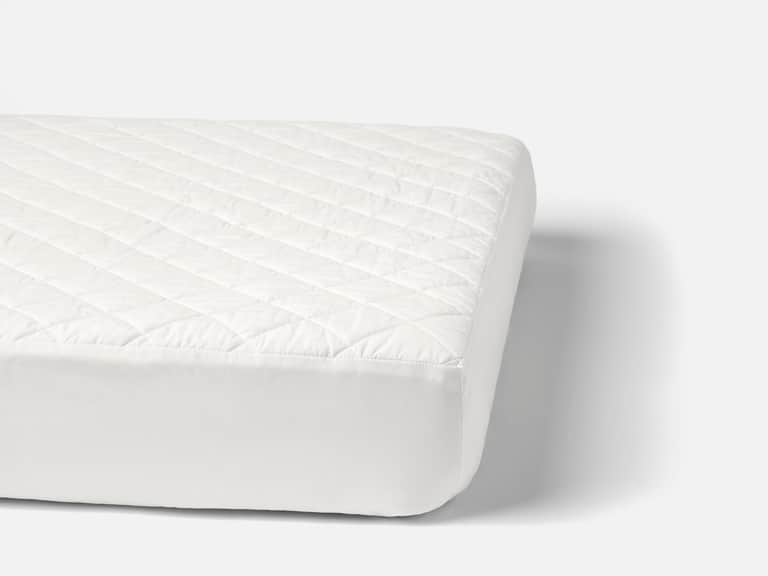
Construction gives a crib pad its character. Quilting stitches the top fabric and filling into a pattern, helping keep the layers together during use and laundering. A two-inch square quilt pattern, for example, creates a regular grid across the surface. That description tells you about the stitching layout; it does not, by itself, mean the pad adds two inches of loft or cushioning.
A percale cover is a plain-weave cotton fabric. The weave and the stated thread count offer some context about the textile, though neither should be treated as a complete measure of comfort or durability. A 220-count percale cover suggests a particular fabric specification, but the finished hand, stitching, laundering performance, and fit all contribute to the experience. For a crib pad, the most relevant question is not whether the surface feels plush, but whether the product is designed for the intended mattress and can be used beneath a fitted sheet without compromising a snug, flat sleep setup.
Natural fibers can absorb moisture, but a cotton pad is not automatically waterproof. If protection from liquids is essential, check explicitly whether the design includes a waterproof barrier. A barrier may change how the pad feels, how it breathes, and how it should be washed. Never infer waterproof performance from “organic,” “quilted,” or “protective” wording alone.
For a product example, the Organic Crib Mattress Pad is described as using 100% organic cotton inside and out, with a two-inch square quilt pattern, a 220-count percale cover, and GOTS certification. Its listed care is a cold, gentle machine wash and low-temperature tumble dry. As with any pad, families should verify its dimensions and intended use against their own mattress and follow the current instructions supplied with both.
Fit is a safety and housekeeping detail
A pad can have beautiful materials and still be the wrong choice if it does not fit the crib mattress as intended. Start with the mattress manufacturer’s guidance and the pad’s dimensions. Standard crib mattresses are commonly listed around 28 by 52 inches, but dimensions and thickness can vary. Confirm the actual measurements rather than relying on a general label such as “crib size.”
Look for a design that is made to lie flat and stay in place beneath a fitted sheet. The finished arrangement should not bunch, fold, or create gaps. A fitted sheet should fit the mattress snugly, and the sleep surface should remain firm and flat. If the pad shifts, gathers at a corner, or makes the sheet difficult to secure, stop using that combination and check the manufacturers’ instructions.
Pay attention to thickness as well as length and width. A pad intended for one mattress profile may not sit correctly on another. Avoid stacking multiple pads or adding improvised layers to compensate for a poor fit. Extra layers can change the surface and make the bedding harder to secure. In a crib, simplicity is not merely an aesthetic preference; it is the more sensible approach.
Before the first use, inspect the pad and the fitted sheet together. Make sure seams are intact, the surface lies evenly, and the sheet remains firmly secured. Repeat that quick check after laundering, since shrinkage or changes in shape can affect fit over time.
Care instructions: small choices, longer usefulness
Washing a crib pad is part of its function, but the care label should lead. Products that look similar may use different quilting, fabric finishes, stitching, or backing. One pad may be suitable for machine washing and low-temperature drying; another may require a gentler approach. Follow the instructions supplied with the specific item rather than applying a generic routine to all cotton bedding.
For a pad whose care label calls for a cold, gentle machine wash and low tumble drying, use those settings. A mild detergent and an appropriately sized load can help avoid unnecessary strain on the fabric and stitching. Do not add bleach, fabric softener, or other treatments unless the product’s instructions specifically permit them. High heat can contribute to shrinkage or wear, and aggressive washing may affect the quilted construction.
Allow the pad to dry fully before putting it back on the mattress. Damp fabric stored or covered for long periods can develop an unpleasant odor and is not a sensible foundation for fresh bedding. If air-drying is permitted, spread the pad evenly and keep it away from sources of excessive heat. If the care label allows low tumble drying, avoid turning the dryer temperature up to speed things along.
After each wash, check for loose threads, damaged seams, misshapen quilting, or shrinkage. Then test the fit again with the mattress and fitted sheet. Replace a pad that no longer lies flat or cannot be secured as intended. Regular inspection is a modest habit with real practical value.
A considered routine for everyday cleanup
A simple care routine can make nursery laundry less complicated. Keep a spare fitted sheet available so a soiled sheet can be changed promptly while the used one is laundered. If the pad itself needs washing, follow its label and let it dry completely before reuse. The goal is not to create a complicated rotation system, but to make it easy to restore a clean, properly fitted sleep surface.
- Check the pad’s label and the mattress maker’s instructions before setting up the crib.
- Wash before first use if the care instructions recommend it.
- Use the specified wash and drying temperatures to limit avoidable shrinkage or damage.
- Inspect stitching and shape after laundering, and confirm the fitted sheet still sits securely.
- Keep the crib’s sleep surface clear of loose blankets, pillows, toys, and other unapproved items.
For a localized spill, resist the urge to use a cleaning product that the care label does not allow. Spot treatments can leave residues or affect the fabric, and soaking a pad may make it difficult to dry thoroughly. When in doubt, follow the manufacturer’s laundering directions rather than experimenting with household chemicals.
Organic, waterproof, and washable: three different questions
Nursery bedding descriptions sometimes place appealing terms side by side, even though each answers a different question. “Organic” concerns the cotton and its certification. “Waterproof” describes a barrier intended to prevent liquid from passing through. “Washable” describes the care method the product is designed to withstand. One quality does not automatically imply the others.
A cotton pad may be absorbent and washable without being waterproof. A waterproof pad may include a membrane that changes its material profile and care requirements. A certified organic textile may still have construction details that need careful review, including how it fits the mattress and whether the instructions permit the washing routine a family needs.
When evaluating a product, read past the headline. Look for a clear materials list, dimensions, construction details, certification information, and washing instructions. If the description does not say whether it is waterproof, treat that feature as unconfirmed. If fit information is vague, ask the manufacturer before use. Clear specifications are more useful than broad assurances.
Safe sleep remains the essential layer
A crib pad is a bedding accessory, not a safe-sleep device. It does not prevent sleep-related injury, make an unsafe surface safe, or replace guidance from pediatric health authorities. The infant sleep environment should remain simple: use a firm, flat mattress designed for the crib, cover it with a tightly fitted sheet, and keep loose bedding and other soft objects out of the sleep space.
Use a pad only if it is permitted by the crib and mattress manufacturers and can be fitted beneath the sheet without creating bunching, looseness, or extra softness. If instructions conflict or you are unsure whether a product is appropriate, contact the manufacturer or ask your child’s healthcare professional. Current guidance can change, so consult reputable public-health sources for up-to-date safe-sleep recommendations.
These precautions matter regardless of whether bedding is organic, conventional, quilted, or marketed as breathable. A material claim cannot take the place of a secure fit and a clear sleep surface. The most polished nursery is ultimately the one in which every layer has a purpose—and no layer compromises the basics.
A practical checklist before choosing
Before bringing an organic cotton crib pad home, use a short checklist to make the decision grounded in specifications rather than atmosphere:
- Materials: Is the cotton used in the shell, filling, or both? Are other components identified?
- Certification: What certification is stated, and what part of the product does it cover?
- Construction: Is the pad quilted, and does the description explain the fill and stitching?
- Protection: Is it explicitly waterproof, or is it a washable cotton layer without a liquid barrier?
- Dimensions: Do the measurements and intended mattress depth match the crib mattress?
- Care: Can it be washed and dried in a way that suits your household, according to the label?
- Safe use: Do the product and mattress instructions allow this combination, with the pad lying flat beneath a tightly fitted sheet?
This approach leaves room for personal priorities—fiber preference, ease of laundry, or certification—without confusing those preferences with safety guarantees. It also keeps the purchase focused on what a crib pad actually needs to do: fit correctly, withstand appropriate care, and help simplify mattress maintenance.
The cleaner setup is the simpler one
Organic cotton crib pads appeal through a quiet combination of natural fiber, familiar texture, and washability. The details behind that impression are concrete: what the pad is made of, how it is quilted, whether it includes a barrier, how it fits, and what its care label permits. Certification can provide useful context, while thoughtful laundering helps preserve the item’s shape and everyday usefulness.
Choose with the mattress and current safe-sleep guidance in view. Keep the pad flat beneath a secure fitted sheet, follow both manufacturers’ instructions, and avoid adding layers to make the crib feel softer. With those fundamentals settled, a carefully specified cotton pad can be what nursery bedding ought to be: a useful, washable detail that supports a cleaner routine without calling attention to itself.